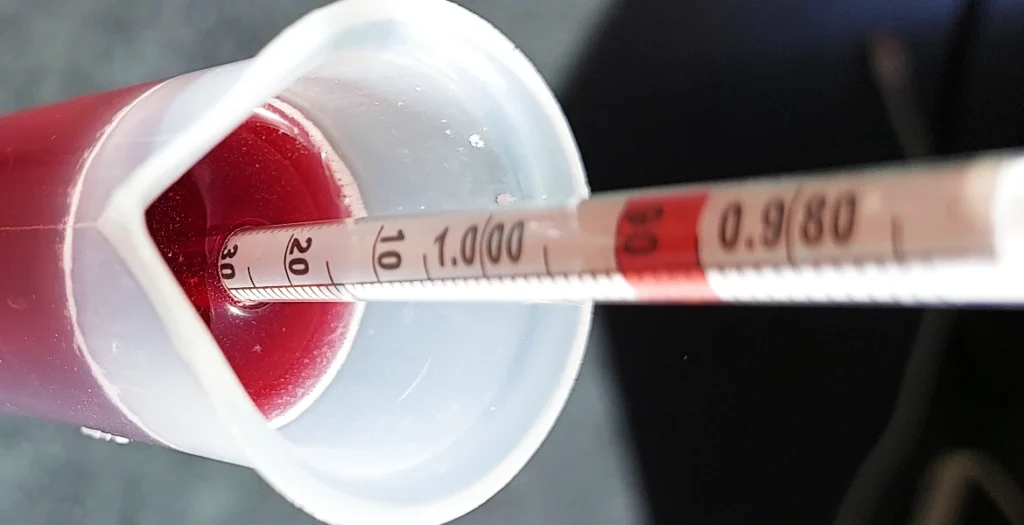
If I could give one piece of advice to every aspiring winemaker it would be this, buy a Hydrometer before you buy anything else. This humble instrument is the backbone of serious winemaking, your compass in the often unpredictable journey from fruit to glass. Without it, you’re working blind. A Hydrometer helps you achieve consistency through precision.
Today, I’ll share the techniques I’ve honed over years of practice. The same methods that have helped countless home winemakers achieve consistent, competition-quality results.
By the end of this article you’ll understand why, after many years of winemaking, I still consider this simple tool non-negotiable.

Why The Hydrometer Is The Winemaker’s Most Important Tool
Let’s be blunt, if you’re not using a Hydrometer, you’re making a guesses. It similar to baking bread without measuring flour, or building a cabinet without a tape measure. You might get lucky, but realistically it’s very unlikely.
A Hydrometer gives you real-time data about the sugar level in your Must. A Hydrometer will enable you to:
- Measure Specific Gravity (SG) – The relative density compared to water. Largely dependent on the sugar content.
- Measure Original Gravity (OG) – The Specific Gravity of a Must before fermentation begins.
- Measure Final Gravity (FG) – The Specific Gravity of a Must once fermentation is complete.
- Enable you to calculate the potential Alcohol By Volume (ABV%) – How much alcohol your wine will contain.
- Determine the amount of sugar needed to reach a required Alcohol By Volume (ABV%).
- Understand whether your Fermentation is your active, slowing or stuck.
- Determine the final finish (sweetness) of your wine – Dry (SG < 1.000), Medium (1.000–1.010), or Sweet (SG > 1.010).
Without these measurements, you’re left with taste alone. While the palate is essential, it’s dangerously subjective. We’ve all tasted a wine that seemed dry, only to measure it and find residual sugar.
As an Amazon Associate I earn from qualifying purchases.
What Does Alcohol By Volume Mean
Alcohol By Volume or ABV% is a unit that describes the precise amount of alcohol (ethanol) in any given drink, expressed as a percentage of total volume. Simply put, it tells you how many milliliters (ml) of pure ethanol you’ll find in every 100 ml of your beverage at 20° Celsius (68° Fahrenheit). It’s the global standard, clear, consistent, and universally trusted.
How A Hydrometer Works (The Science Made Simple)
At its core, a Hydrometer measures density (Specific Gravity (SG)) of a liquid. The Hydrometer made for winemakers is calibrated to measure the quantity of sugar or alcohol in a solution. Both sugar and alcohol affect the density of a liquid. The side of the Hydrometer is incremented in units representing the Specific Gravity (SG) of the liquid. These are the key principles:
Sugar increases the density of a liquid, raising Specific Gravity (SG). The higher the SG, the more sugar there is present in the Must.
Alcohol decreases density of a liquid, lowering Specific Gravity (SG). As sugar is consumed by the yeast, Alcohol is created lowering the SG.
By measuring and recording (tracking) these changes, we can calculate:
- How much sugar was present initially, before fermentation started.
- How much sugar has fermented into alcohol.
- How much sugar remains unused by the fermentation process, if any.
Most Hydrometers are calibrated for 20° Celsius (68° Fahrenheit), but minor temperature fluctuations 15–25° Celsius (59-77° Fahrenheit) won’t throw off your readings enough to matter. One thing to note, try to ensure each sample you take is always the same temperature when taking successive readings.
Taking A Hydrometer Reading: A Step-by-Step Masterclass
Step 1: Prepare Your Sample
- Use a cleaned and sanitized Measuring Cylinder (a plastic or glass graduated Measuring Cylinder works perfectly).
- Fill the Measuring Cylinder to ¾ full with Must or Wine.
- Avoid bubbles or foam. Let any bubbles settle before taking a reading. We need a flat clear surface on the liquid.
Step 2: Insert The Hydrometer Properly
- Gently lower the Hydrometer into the Measuring Cylinder. Be careful not to drop it as it can impact the bottom of the Measuring Cylinder.
- Using your thumb and forefinger, gently spin the neck of the Hydrometer. The spinning will dislodge and bubbles clinging to the sides of the Hydrometer giving you a clear view of the scale.
- Let the Hydrometer settle to a stop completely before taking a reading.
Step 3: How To Read A Hydrometer Correctly (Most Beginners Get This Wrong)
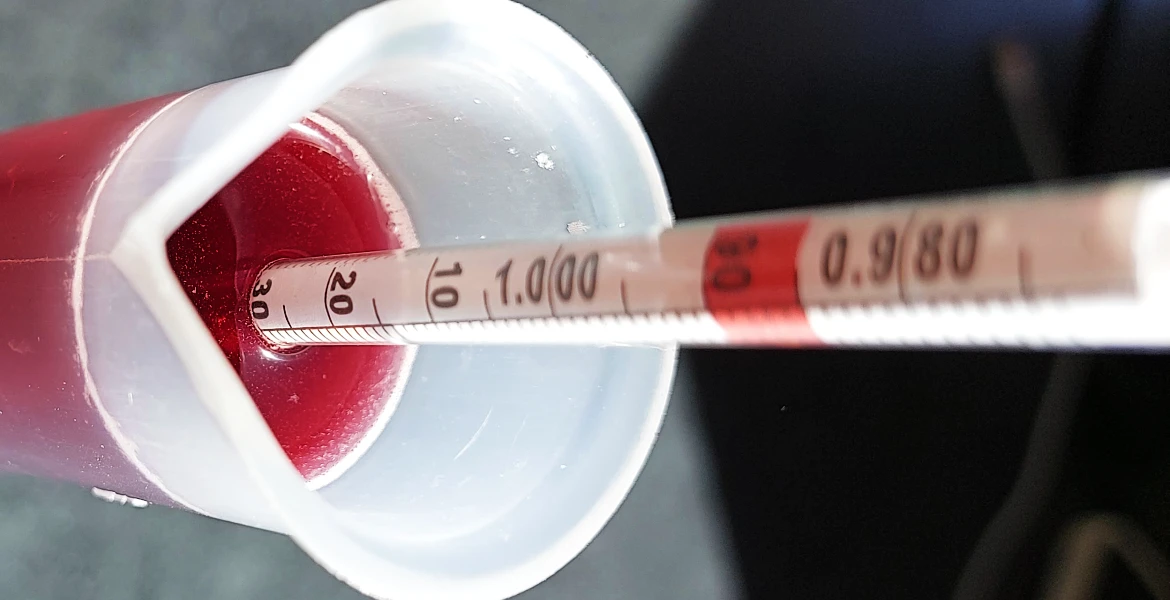
- To read a Hydrometer correctly, you must view the scale at eye level. This means, getting down next to your Measuring Cylinder. Look through the side of your Measuring Cylinder and write down the number on the scale of the Hydrometer that is level with the surface of the liquid.
- Ignore the curved Meniscus (the curved upper surface of the liquid in the Measuring Cylinder), record the reading at the bottom of the curved surface where the liquid meets the scale.
- For every wine you make, keep a notebook. As a bare minimum, record your Original Gravity (OG) before fermentation, and Final Gravity (FG) at the end. When you read our recipes, you’ll see we prompt you to make notes as you progress.
Calculating Alcohol Content: The Winemaker’s Golden Formula
This is the equation every winemaker should memorize:
Alcohol By Volume (ABV%) = (Original Gravity (OG) – Final Gravity (FG)) * 131.25
Let’s step through a worked example, so you can see the formula in action:
- With an Original Gravity (OG) reading of 1.085
- With a Final Gravity (FG) reading of 1.000
- We need the difference: Original Gravity (OG) – Final Gravity (FG) or 1.085 – 1.000 = 0.085
- Alcohol By Volume (ABV%) is calculated as 0.085 * 131.25 = 11.16%
Why do we use 131.25 in the formula? It’s a simplified constant. The constant 131.25 accounts for the number of grams of Ethanol generated per gram of carbon dioxide released during fermentation and also represents the approximate density of Ethanol produced during fermentation, which is necessary to convert from Alcohol by Weight (ABW) to Alcohol By Volume (ABV).
Actual alcohol yield varies slightly, but this gets you within 0.5% accuracy, which is more than enough for home winemaking.
What If You Add Sugar Mid-Fermentation?
For high Alcohol By Volume (ABV%) wines, you’ll often step-feed sugar (add sugar in small batches over many days). This is done so you don’t overwhelm the yeast. As you plan to add more sugar to your Must, take a sample and record the Specific Gravity (SG) both before and after the addition of the sugar. Record these readings in your notebook. Track each addition’s SG drop and sum them at the end. The following is a worked example:
| Stage | SG Reading | Change |
| Original Gravity (OG) | 1.060 | |
| After 4 Weeks | 1.030 | 0.030 |
| Addition Of Sugar | 1.050 | |
| After 4 Weeks | 1.020 | 0.030 |
| Addition Of Sugar | 1.040 | |
| Final Gravity (FG) | 1.000 | 0.040 |
| Sum | 0.100 |
0.100 * 131.25 = 13.13 % ABV
Sugar Adjustments: Hitting Your Target ABV Like a Pro
Your Hydrometer lets you calculate sugar additions with precision. Using the following table, you have a guide to the relationship between Specific Gravity (SG) and the potential Alcohol By Volume (ABV%) when fermentation is complete.
Quick Reference Table: Specific Gravity To Alcohol By Volume
| Specific Gravity (SG) | Sugar Weight (g per 4.5 L) | Potential ABV% |
|---|---|---|
| 1.000 | – | 0.00 |
| 1.005 | 70 | 0.65 |
| 1.010 | 140 | 1.31 |
| 1.020 | 280 | 2.63 |
| 1.030 | 370 | 3.94 |
| 1.040 | 500 | 5.25 |
| 1.050 | 610 | 6.56 |
| 1.060 | 730 | 7.88 |
| 1.070 | 860 | 9.19 |
| 1.080 | 980 | 10.50 |
| 1.090 | 1100 | 11.80 |
Common Hydrometer Pitfalls And How to Avoid Them
1. Carbon Dioxide Bubbles
- Active fermentation produces Carbon Dioxide (CO₂) gas, which affects Specific Gravity (SG) readings.
- The Fix: Degas your sample by stirring your sample with spoon, before measuring with a Hydrometer.
2. Non-Sugar Solids In Sample (Pulp, Pectin, Haze)
- Cloudy musts is not a big issue. Expect slightly higher Specific Gravity (SG) readings from Must containing suspended particles. No action needed.
3. Temperature Extremes
- Sample is too hot or too cold? Density changes with temperature. Minor temperature fluctuations 15–25° Celsius (59-77° Fahrenheit) won’t throw off your readings enough to matter. One thing to note, try to ensure each sample you take is always the same temperature when taking readings with your Hydrometer to ensure reliable results.
Final Sweetness: Dry, Medium, Or Sweet
Your Hydrometer doesn’t just measure alcohol, it highlights your wine’s finishing style.
- Dry: SG < 1.000 sugar is fermented out.
- Medium: SG 1.000–1.010 hint of residual sugar.
- Sweet: SG > 1.010 noticeable sweetness on the palate.
Choosing The Right Hydrometer
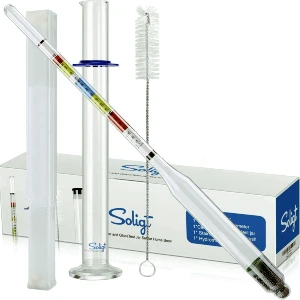
- Glass Hydrometers are precise and easy to find.
- Always get a Measuring Cylinder/Flask with your Hydrometer.
- Ensure your Hydrometer has the specialized ranges 0.990 to 1.170.
As an Amazon Associate I earn from qualifying purchases.
Final Thoughts: How To Use A Hydrometer For Winemaking
After decades of winemaking I’ve learned this. The difference between good and great wine isn’t luck, it’s measurement using a Hydrometer. A Hydrometer gives you:
- Control over alcohol and sweetness.
- Confidence that fermentation is on track.
- Consistency in every batch.
So, if you take one thing from this guide let it be this, Respect the Hydrometer. Use it religiously. And watch your winemaking transform.
Now, go forth and measure with authority. And when you “pull the cork” on your first bottle of Wine, don’t forget to share your victory with us. We’d love to read all about your success, so drop us a line and tell us everything.